
Importance

1. Importance of Security

Security is paramount in society, as human relationships are unsustainable without it. People need to feel safe to build trust with others. Without trust and safety, productive socio-economic interactions are impossible. We often take these fundamentals for granted, and their importance only becomes apparent during periods of crisis when there is a general breakdown of order.

For a developing country such as The Gambia, the importance of security cannot be overemphasized. Individuals need a secure atmosphere to go about their daily livelihoods. Security of life and property is essential for local businesses to invest and operate. It is even more critical for foreign investors, who have less attachment to the country than citizens and may flee after experiencing minimal insecurity. Without local and foreign investments, the economic growth required to move us from fragile country status cannot occur.

2. The Current Security Situation in The Gambia

What is remarkable about the security sector in The Gambia today is how unchanged it remains relative to what it was under the Yahya Jammeh administration. Its defining features or symptoms include the following. It is worth noting that, while these features are manifested in operations, the causes are rooted in policy.

a. Deterioration of local security: The country does not maintain reliable crime statistics, making it difficult to cite specific figures. Nevertheless, the deterioration in the country's security situation—ranging from petty theft to major drug smuggling operations to serious armed robberies—is as evident as the dramatic increase in the cost of living. Armed robberies of banks, which had never occurred in the country before, have now happened multiple times. Even international criminals are now using The Gambia as a base, as evidenced by recent arrests of Asian cyber criminals in the country.

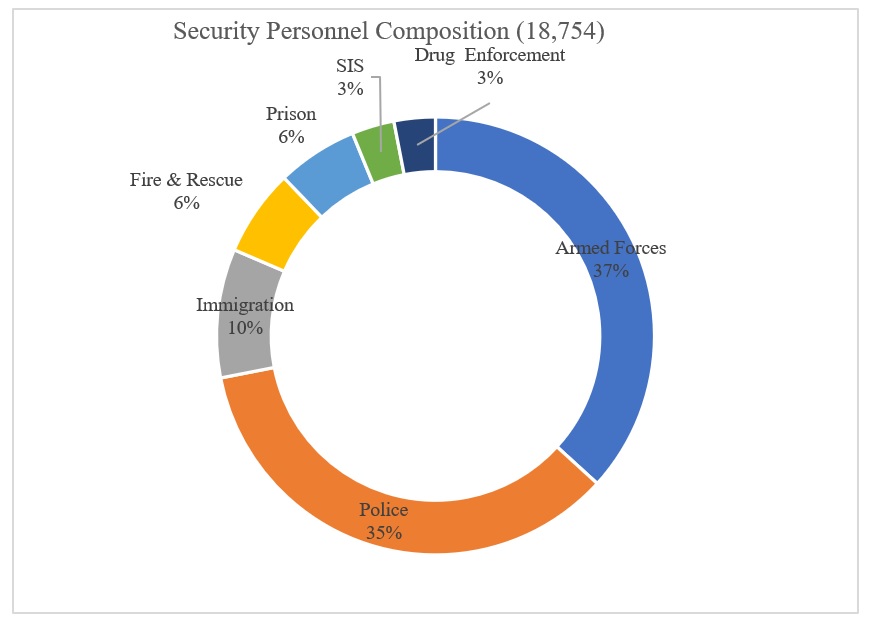
b. Bloated security sector: In 1994 when Yaya came to power, the size of the security forces was quite small, with the army having only about 1000 soldiers. To serve Jammeh's authoritarian regime, the overall size of the security services expanded dramatically. By the time Jammeh left power in early 2017, the total number of security sector personnel (armed forces, police, immigration, Fire & Rescue, Prison, Drug Enforcement, and SIS) exceeded 18,000. As of mid-2025, the personnel size has grown to approximately 20,000. This means the security sector has actually expanded under the current government.

The largest component of the security sector in terms of personnel is the armed forces, accounting for 37%—more than the police's share. Given that The Gambia faces no external threat to its territorial integrity and domestic security is currently a major concern, this composition is problematic. Moreover, the armed forces' budget far exceeds the amount allocated to the police. The presence of numerous checkpoints and rights violations indicates a cultural mindset in that branch that has not changed significantly.

Figure 1: The composition of the security sector in The Gambia as of 2018.
The unchecked size of the security sector has resulted in an unsustainable number of security personnel across all service branches. For example, security personnel (approximately 20,000) represent about half the total size of the public sector. Given the country's low-income status and high debt burden, this represents a massive and unsustainable public finance burden on the economy.

c. No change in security personnel practices: Despite the cessation of more dramatic occurrences such as forced disappearances, other hallmarks of security services under Yahya Jammeh have unfortunately remained. These include abuse of power by security agencies, such as routine denial of demonstration permits, ubiquitous checkpoints, arrests of individuals under flimsy legal pretexts, and frequent disregard of due process. In fact, ordinary Gambian citizens must navigate more police checkpoints today than they did under the Yahya Jammeh regime. More ominously, military checkpoints remain even though the country is not under martial law.
current state

3. The Government's Mishandling of the Security Situation

The current government's handling of the security sector involves perpetuating the status quo instead of seizing the unique opportunity to implement security sector reform. The government has made no progress toward security sector reforms despite receiving millions of dollars in support from the EU, UN agencies, and ECOWAS.

a. No security for the people: The current government's handling of the sector suggests insufficient reflection on the fundamental question of who needs security the most. What should be abundantly clear is that the security of the people should take precedence over the security of the government. Having real security means not just being free from danger but having the freedom to live with dignity and without fear. By that metric, the average Gambian cannot be accurately considered to be enjoying freedom, given the explosion in crime rates and abuse of authority. The one person who can unambiguously be considered to be enjoying freedom in The Gambia today is President Adama Barrow, who has the luxury of being guarded by foreign soldiers behind the high walls of the State House.

b. Lack of security sector reform implementation: The security sector in The Gambia is among the sectors most in need of reform in the country. After 22 years of dictatorship, the size, composition, posture, and culture within all units of the security system needed complete overhaul. Rather than providing security for citizens, the security sector became a weapon of terror against ordinary people under Yahya Jammeh's rule. Unfortunately, the Adama Barrow regime has not implemented any security sector reform. Despite all the significant assistance received from outside sources, only a few documents were prepared, some billboards erected, and minor consultations held. Well-qualified Gambians with appropriate backgrounds in the security sector were not involved. As a result, the security situation remains largely unchanged. What’s more, m any unfortunate practices common under the Jammeh regime continue to be experienced.

c. Continued ECOMIG presence: Another visible feature of the failure of security sector reform is the continued presence of the ECOWAS Military Intervention in The Gambia (ECOMIG). ECOMIG played a major role in installing the democratically elected government after Yahya Jammeh's defeat. However, it was always understood that their presence would be temporary. Indeed, the Adama Barrow government was expected to implement security sector reform that would eliminate the need for foreign military presence. Not only is ECOMIG still present in the country, but there is no timeline for their withdrawal as of mid-2025.

intervention

4. PPA’s Solutions for Security Sector Reforms

To gauge the success of reforms, their effects must be visible to the average Gambian in terms of the size of security forces, the professionalism with which they interact with citizens, and their ability to improve the security situation for people. If these effects are not felt by the average citizen, then there have been no meaningful reforms. In crafting an appropriate security policy to guide the needed security reform, we must be cognizant of two main facts about the Gambian context:

  • No external threat: The Gambia currently faces no outside threats to its territorial integrity. The country is surrounded on all sides by Senegal. As long as the country maintains good relations with Senegal, there is no reason to waste resources on a bloated military.
  • Increase in local crimes: There has been a significant upsurge in local criminal activity in The Gambia, including break-ins, robberies, murders, arsons, and rapes. This has created a heightened atmosphere of fear and insecurity in the country. To compound this increased lawlessness, local police are poorly equipped, poorly paid, and inadequately trained.

    To carry out the needed security sector reforms and improve the sector in the country, our government will implement the following:

a. Primacy of domestic law enforcement: Our government will prioritize local law enforcement for the country's security services. Enforcement of law and order is the primary need citizens have from this sector. Meeting this need will require a professional, well-equipped, and well-compensated local law enforcement service led by the police. It will require a police force with a size and distribution commensurate with the country's needs. Furthermore, the individual filling the national security adviser position should have a profound understanding of law and order in our country's context.

b. Appropriate personnel size: Under our government, the military's size will be brought to a level that makes sense for the country's context. The armed forces must have a size consistent with the needs of a country that is not at war and does not face external threats to its territorial integrity. Correcting the size would enable the government to properly compensate recruited soldiers, including not only decent salaries but also better living arrangements.

c. Revisiting legal foundation: The legal foundation of the entire security sector in The Gambia was created during the Yahya Jammeh administration, which was a dictatorship. For example, an outsized role has been given to the military and other security agencies that were designed for the security of the government at the expense of the people. This is clearly not the proper legal foundation for security agencies in a democracy. Our government would immediately ensure that the constitution and all legal statutes are revised to make them fit for purpose in a democratic context (Refer to the legal sector document).

d. Withdrawal of ECOMIG: While acknowledging the important role played by ECOMIG in removing the dictatorial regime, our government would immediately establish a timetable with our partners in ECOWAS for the orderly withdrawal of ECOMIG. The continuous presence of ECOMIG is not conducive to creating a local force designed to meet the country's security needs. It is time for reformed, home-grown security forces to assume their proper role in providing security for the nation as a whole.

solutions

Follow us on @ Electionify