
Importance
1. The Importance of the Gambian Diaspora
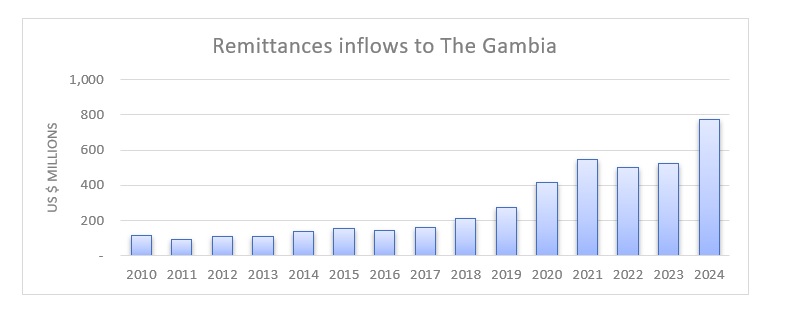
The diaspora is a vital component of Gambian society. By some estimates, the diasporan community comprises approximately 150,000 individuals. In the economic realm, it is not an exaggeration to say this group keeps the Gambian economy afloat. Remittances from the diaspora for 2024 exceeded US$700 million. For a large number of Gambian households, meeting essential expenditures would be impossible without help from relatives abroad.
Figure 1: Remittance inflow to The Gambia in US dollars
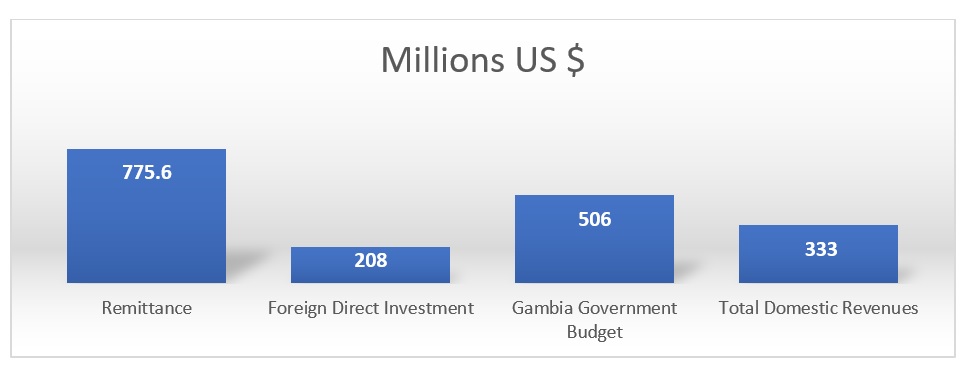
To fully appreciate the scale of remittances sent by Gambians living abroad, it is instructive to compare its value with other key economic indicators. The total value of remittances in 2024 were more than three times that of foreign direct investment (FDI), about 50% more than the Gambian government budget, and about three times the value of domestic revenues collected by the government.
Figure 2: Remittances in comparison

2. The Standard Narrative
The above section summarizes the standard narrative about the Gambian diaspora, which is mostly centered on the financial assistance they provide through remittances. It is time we move beyond this incomplete narrative. While not inaccurate, it fails to fully appreciate the great potential the diaspora holds for the country. Yes, remittance inflows are huge, but most of the funds go toward direct consumption rather than needed high-return investments.
The focus on remittances overlooks an arguably more important contribution that members of the diaspora can make to the nation's development: human capital. By living and working in more advanced countries, these citizens have been exposed to cutting-edge technologies, processes, and innovations.
standard
track record
3. Government's Track Record on the Diaspora
The current government's position on the Gambian diaspora is characterized by empty gestures while ignoring their concerns and failing to appreciate the potential they hold for the country's development.
- Disenfranchisement: When the Adama Barrow government came to power in 2017, there was initially much discussion about the importance of the diaspora. Unfortunately, no concrete results materialized. One of the most important elements of civic participation is voting. Despite the large number of Gambians abroad and their immense contribution to the economy, there has been no change in the situation to make it easier for the diaspora to vote in Gambian elections. The 2021 presidential and 2022 National Assembly elections came and went while a large number of citizens were deprived of the opportunity to participate. The few who voted had to do so at immense cost by traveling to register and then returning to vote within a six-month period. For most Gambians abroad, this is too onerous a cost.
- Absence of trust and disappointment: A major way for a government to earn the confidence of its citizens—whether they are domestic residents or diaspora—is to build a strong economy where citizens are able to comfortably visit and invest. This has been another major failure of the government. After the end of the Yahya Jammeh dictatorship, many Gambian citizens abroad looked forward to returning to reside or invest. But if anything, the economic situation has worsened.
4. Solutions
First and foremost, we must acknowledge the obvious point that the Gambian diaspora are citizens who are entitled to all rights and opportunities afforded to citizens resident in The Gambia. Therefore, it is important that they enjoy all the benefits of citizenship and have the opportunity to meaningfully contribute to development—these are important for their own sake, beyond their instrumental value to our economy. We must also recognize the immense contribution and potential of our fellow citizens who are able to travel abroad and make a living there. Our government will start a new chapter of engagement with the diaspora through the following actions:
- Enfranchisement: Our government will immediately put in place mechanisms to ensure that Gambian citizens abroad will be able to vote in legislative and presidential elections. This is their right as citizens, and fundamental rights are not open to negotiation. Voter registration processes will be amended to allow Gambians abroad the opportunity to vote. The living reality of most Gambians abroad rules out the possibility of traveling to Gambia twice within a six-month period to register and to cast a vote.
- Allowing the Diaspora to Contribute to Economic Development: In order for Gambians in the diaspora to have the comfort and confidence to invest at home, certain easy-to-implement conditions must be met. The country urgently needs legal reforms to ensure that commercial disputes are adjudicated within a reasonable time frame. Countless Gambians have been defrauded, with the perpetrators knowing they can get away with it due to the absence of credible recourse. After all, cases filed in court languish for years before being decided. Clear criminal cases that get reported to the police rarely result in prosecution. This will not continue in our government. Administrative processes need to be streamlined and rationalized.
- Diaspora-led Investment: There should be recognition that the return of just a small fraction of the Gambian diaspora is enough to transform the economy. It takes a certain kind of entrepreneurial spirit to leave the comfort of one’s home and spend years abroad to make a living. By the very nature of their journey, every person within the diaspora is unafraid of taking reasonable risks. Indeed, the most dedicated and impactful investors our country can attract today are Gambians abroad who are ready to come back not only with financial capital but also with innovations and knowledge. Given the size of our diaspora, even if only a few were to return to make long-term investments in the country, the economy would be significantly transformed. Speaking to Gambians in the diaspora, one comes across individuals willing to invest in all sectors, including agriculture, energy, information technology, housing, health services, financial services, and manufacturing, among others.
solutions
- Diaspora as a Source of Long-term Finance: There are many needed long-term investments that the country requires, but they are not being implemented because of lack of financing. Given the size of the annual remittance inflows to The Gambia, one can get a glimpse of the potential source of long-term finance if properly tapped. There will be no shortage of Gambians abroad willing to invest in a well-designed and well-managed project with sufficiently high financial and social returns. Let’s consider some examples. Consider a toll road project in the country or a new electricity generation project. These are the sort of projects that can be difficult for the country to finance and would be extremely expensive to finance through foreign banks. But a diaspora bond issuance would be oversubscribed if Gambians abroad are convinced by the economic and social case for the project. The project would need to be put together by individuals with the competence to do so, such as those with project finance expertise. The implementation units would need to be staffed by individuals with expertise to execute the project rather than just bureaucrats. With those key assurances, any bond issuances by The Gambia would have yields higher than alternative long-term investment instruments, and there should be no difficulty for the country to attract long-term finance to undertake impactful investments in infrastructure or other sectors.
- Effective Engagement: Our current Ministry of Foreign Affairs does not have an effective engagement strategy with our Gambian diaspora. Many Gambians living in countries that have our embassies do not know our diplomatic staff. For a country with such a high proportion of citizens abroad, it is vital that our foreign affairs staff place high importance on effective engagement to address issues of concern. Our government will create a structure where diasporan liaison positions will be created to effectively engage with this particular group of Gambians.
Follow us on @ Electionify