
2. The Status Quo in ICT
The Gambia has made progress in some areas of ICT. For instance, the country exceeded 100 cellular subscriptions per 100 individuals since 2014. However, in many areas of ICT, The Gambia is lagging significantly behind. In 2020, the country was ranked 119 out of 130 in the Network Readiness Index (NRI), which measures how prepared countries are to utilize ICT. By 2024, The Gambia had fallen so far behind that it was not even ranked in the NRI index. Some of the driving factors behind the country's lag in ICT include the following:
a. High cost: The cost of digital and internet services in The Gambia is high relative to other African countries. For example, the average cost of 1 gigabyte of data in The Gambia is over $1.50 among mobile operators, while the African average is about $0.38. This high cost is a significant barrier to the penetration of broadband connectivity.
b. Unreliable mobile access: Despite its small size and population density, the level of connectivity in much of The Gambia is very low. This is true not only for 4G but even for voice connections. It is a common occurrence to make several attempts before voice calls are connected.
c. Low broadband connectivity coverage: The coverage of 4G connectivity is very low. Only limited areas of the country have 4G connections that can enable internet service. It is not uncommon for residents in rural areas to depend largely on Orange (a Senegalese telephone company) because it has better connection than any of the local operators.
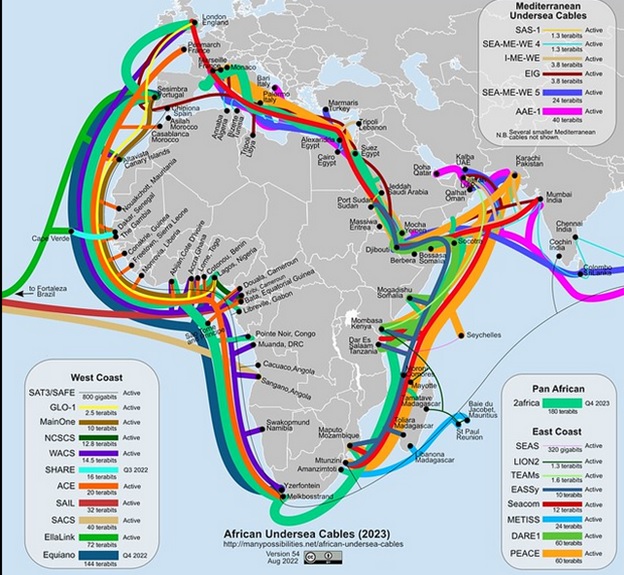
d. Limited backbone connection: One of the key reasons for these low-quality ICT services is the single submarine/undersea cable connection the country has with the rest of the world. Submarine cables provide some of the highest broadband and lowest-cost data connectivity in the world. As a result, they account for more than 95% of all voice and data transmissions globally. The Gambia is currently connected to only one submarine cable, which is the Africa Coast to Europe (ACE). This is insufficient for the country's connectivity needs. In the event of cuts to that cable, which has happened on a few unfortunate occasions, the whole country experiences an internet blackout. Our neighbors in West Africa that have quality connectivity are connected to at least two submarine cables. There are several other submarine cables that are accessible to the country, such as MainOne, WACS, and SHARE.
Figure 1: Sub-marine cables around Africa




3. Government
The government has a critical role to play in the ICT sector. It must formulate the right policies and put in place the appropriate regulatory regime. Some of the major issues regarding the government's role in the Gambian context are highlighted below:
a. Lack of investment in relevant infrastructure: The government is uniquely placed to make infrastructural investments because of their public good nature. In the case of ICT, investments in backbone infrastructure are critical. Examples of this backbone infrastructure include nation-wide fiber-optic investment and connection to undersea cables. While some of these investments have occurred, there have been gaps in the quantity and the manner in which they have been implemented.
b. Poor regulatory environment: The relevant regulatory agency is the Public Utilities Regulatory Authority (PURA). The major issue with PURA has been the leadership installed by the president. Mr. Njogu Bah has a well-established reputation for corruption and incompetence under the previous administration. Yet despite this reputation, the current government decided to place him in charge of this important regulatory agency. Irrespective of the number of competent officials in PURA, the fact that they are being led by such an individual is sufficient to conclude that PURA cannot undertake its work effectively. As such, the implementation of important regulatory matters in ICT has suffered and will continue to do so.
c. Mismanagement of relevant state-owned enterprises (SOEs): The two relevant Gambian SOEs are Gamcel and Gamtel. These SOEs have been chronically mismanaged, which can be seen from their financial positions below. Specifically, the combined assets of these SOEs total D 2.4 billion, while their combined liabilities are D 3.6 billion. In other words, both of them are financially insolvent. The reforms that are needed for both of these enterprises are well known. What has been lacking is leadership and political will.
Figure 2: Assets and liabilities of Gamcel and Gamtel in 2024.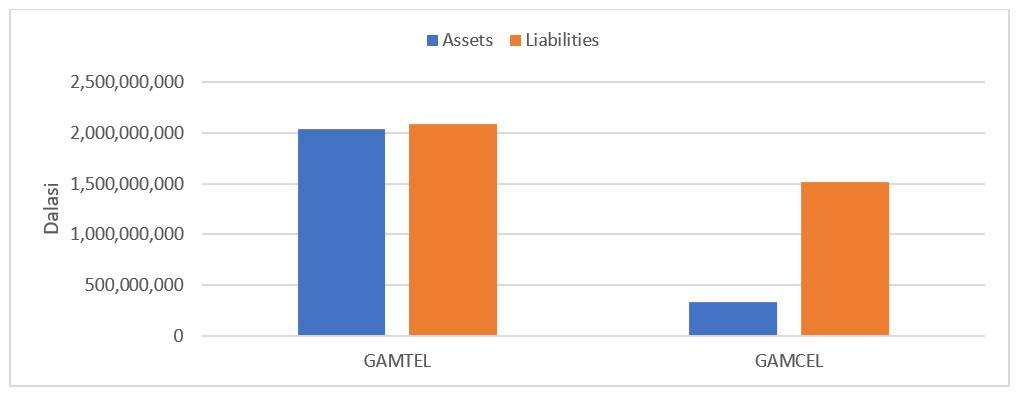
d. Absence of e-government services: There is an almost complete absence of e-government services in The Gambia. For example, Gambian identity cards and driver's licenses have embedded microchips on them that now serve only as ornamental pieces because they contain no digital data and the government has no information system in place to connect them. It is not surprising that The Gambia was ranked 181 out of 190 globally in the UN's e-Government Development Index. Not only does the government fare poorly on a global scale, but its rank is also low by sub-regional standards. A government that has not made the required investments in ICT and has not put in place the requisite legislative, policy, and regulatory frameworks, as well as their proper execution, does not have the readiness for e-government.