Importance

1. Importance of Agriculture in the Gambian Economy

The agricultural sector accounts for about 20% of The Gambia's GDP, approximately 40% of the country's net exports, and about 17% of employment. Around 60% of households derive a significant portion of their income from this sector. The most important factor of production in agriculture is land, and the country has an arable land area of 440,000 hectares, representing about 40% of the country's total land area. Despite these significant figures, agriculture's potential for driving Gambian economic development remains largely untapped.

Agriculture is essential for meeting the most basic human need: food security. Additionally, locally productive agriculture is crucial for economic wellbeing, as dependence on imports exposes the country to external shocks. Recently, this has been a major source of inflation in The Gambia, increasing the cost of living. Agriculture is labor-intensive, meaning that a growing and productive agricultural sector can absorb a significant share of the labor force, thereby increasing incomes and reducing poverty. Cash crop and horticultural production can boost net exports, generate foreign exchange revenue, reduce depreciation pressure on the local currency, and improve the current account balance. Agricultural productivity growth is also essential for providing inputs to processing industries, helping to kick-start industrialization and enable economic transformation.

2. What Is the Current State of Gambian Agriculture?

To properly understand the current state of affairs, it is important to broadly categorize the sector into three sub-sectors: (i) traditional crop production; (ii) horticultural production; and (iii) livestock.

(i) Traditional Agriculture

This is the main or traditional form of agriculture in The Gambia. Our main staple, rice, belongs in this group. Groundnut, our main cash crop since before independence, also belongs in this category. By area of land cultivated, these crops account for the largest share of the arable land cultivated in the country. This type of agriculture takes place principally during the rainy season. The only exception is that rice cultivation can take place in irrigated areas of CRR. Because this type of agriculture is rainfall-dependent in The Gambia, the biggest predictor of production and productivity is rainfall. This also means that there has been no sustained growth in productivity of these crops, since droughts frequently wipe out gains from any bumper harvests.

(ii) Horticulture

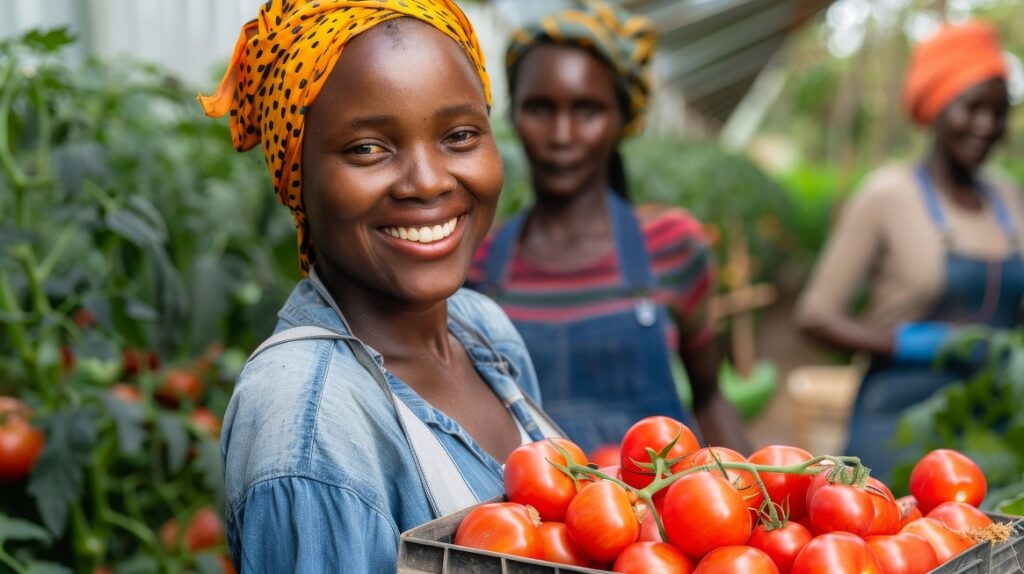
Horticulture is a high-return activity because it involves intensive cultivation of high-value vegetables and crops. Unlike traditional agronomy, which requires a large amount of land, one can extract a significant financial return on a small parcel of land in this sub-sector. Within the Gambian context, horticulture can be categorized along two dimensions. On one dimension, it can be categorized by the type of plants grown: (i) vegetables (e.g., onion, tomatoes, eggplants, lettuce, etc.) and (ii) high-value tree crops (e.g., apples, avocado, banana, cashew, mango, orange, papaya, etc.). Another dimension is the type of groups that partake in horticultural production: (a) private agribusiness firms and (b) communal gardens that are mostly located in villages and predominantly involve women.

The horticultural sub-sector is simultaneously the most potentially lucrative sub-sector and the most neglected by the government. Virtually all assistance to the sector comes from projects financed by donors or local philanthropists. Particularly neglected are women vegetable growers. These farmers, most of whom are located in rural areas, receive no support from the government in terms of inputs and infrastructure. The main challenges faced by this sub-sector are seeds, irrigation, pest control, storage, marketing, and processing.

Marketing of their produce faces major challenges, which leads to significant post-harvest losses. All horticultural producers—whether they are rural women or private agribusiness firms—face major challenges in accessing specialized inputs such as seeds, fertilizer, and pest control mechanisms.

current state

(iii) Livestock

The livestock sector is estimated to account for 40% of total agricultural output. The economically important livestock in this agricultural sub-sector are cattle, goats, sheep, horses, donkeys, pigs, poultry, and bees. Livestock activities are undertaken in all regions of the country. The problems facing the livestock sector are well-known. There is a long-standing problem of lack of production inputs such as feed, water, and veterinary services.

  1. Feed: Cattle, donkeys, horses, and small ruminants still depend on fodder that becomes limited in supply during the long dry season. Commercial poultry production (layers and broilers) has failed to take off due to the high cost of imported feed.
  2. Water: Access to water for livestock is a major problem, particularly for cattle. The search for water in the dry season is also a major source of conflict between livestock owners and crop growers, particularly in the Central River Region and Upper River Region.
  3. Veterinary Services: Productivity in the livestock sector is highly limited due to inadequate veterinary services. This means that frequent outbreaks of livestock diseases decimate their population, leading to significant economic losses.
  4. Breed Diversity: There is limited breed diversity for most livestock. While local breeds are highly adapted to our unique climate, the limited diversity restricts opportunities to undertake cross-breeding, where significant gains in yields of meat, milk, and eggs can be realized.

This lack of inputs is a major constraint to expanding production and productivity.

Intervention

3. Typical Government Intervention in Agriculture

There has not been any change in the way the government approaches the agricultural sector since the colonial period. The Jawara regime, the Jammeh regime, and the Barrow regime have all followed the same approach to agriculture and have all experienced the same predictable lack of results. This approach can be described as follows: provide limited assistance to farmers with seeds and some fertilizers at the beginning of the rainy season and help buy their produce from them after harvest. In most years, this support is restricted to groundnut but occasionally extends to rice. In a nutshell, this represents the core government support to agriculture since the colonial period. Despite the repetitive and predictable nature of this type of intervention, its implementation has never been satisfactory.

  1. Mishandling of Input Supply: The fertilizers that the government supplies each year to farmers frequently arrives late. Most farmers have learned not to depend on it due to the government's lack of reliability. Furthermore, the supply of the fertilizer, which is frequently NPK and urea, is not accompanied by any efforts at sensitization on their proper application.
  2. Poor Compensation of Farmers: Each year, the government promises to buy groundnuts from farmers. Indeed, farmers are threatened against selling the groundnut elsewhere each year. Yet, the government fails to pay on time almost every single year. Some farmers only receive their payment on the eve of the following rainy season.
  3. No Focus on Other Major Crops: Another distinguishing feature with regard to government involvement in agriculture has been the almost exclusive focus on traditional crops, which are groundnut and rice. There has been no systematic support for other major cereals such as maize, millet, sorghum, or findi. Another neglected area has been horticulture. The little support that is given to horticulture often comes from donor-funded projects and philanthropic groups.
  4. Improper Procurement: Many agricultural projects—whether donor-funded or government-financed—have been plagued by corruption during the procurement process. Examples include the procurement of tractors, the development of land, and the implementation of numerous donor-financed agricultural projects.
  5. Neglected Agricultural Research: Agricultural research has been largely neglected, as can be seen in the dilapidated state of agricultural field offices around the country. This is most visible in Sapu, located in CRR, which used to be a major agricultural station. Today, the buildings in Sapu are in a sad state, with weeds overtaking buildings. The national agricultural research institute (NARI) has also been neglected with limited funding.

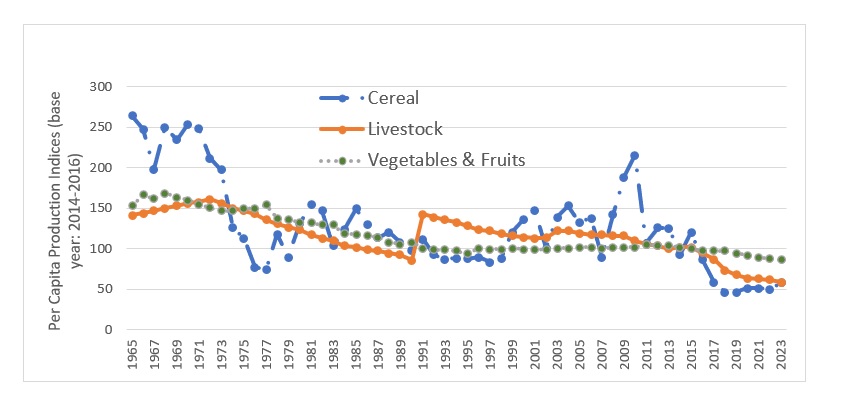
Not surprisingly, agricultural productivities of the major crops (groundnuts, maize, millet, sorghum, and rice) have not only failed to grow but have actually declined on average over time. As the figure below shows, the productivity of cereals, livestock, and horticultural products has been on a downward trajectory since independence.

Predictably, the results have been bleak in terms of food security, rural development, and structural transformation. Both the levels of production and the yields of our major crops have remained stagnant while those of neighboring countries have been growing. The country is hugely exposed to food shocks, given our small size and complete dependence on imports. Our entrepreneurial farmers who want to venture into poultry find it difficult to stay profitable given the high cost of imported feed. Instead of eating local healthy chicken, we only consume mass-produced imported frozen chicken coming all the way from Europe.

Figure 1: Trends in agricultural productivity growth since independence.
4. PPA's Solutions

Given the importance of agriculture not only for food security but also for economic transformation, it will be a major priority for the PPA-led government. In addition, PPA's approach will be transformational rather than piecemeal. This approach will necessitate deviating from pursuing the same activities that have not produced any meaningful results. Proactive steps involve bold vision and actions with goals toward food security and agricultural-led structural transformation that will lead to poverty reduction and economic growth.

  1. Year-Round Agriculture with Major Infrastructure Investment: Transformative solutions require bold and audacious actions. Rainfall is the main predictor of agricultural production and productivity in The Gambia because the sector is completely rainfall-dependent. This cannot continue. The country needs a massive and bold investment in irrigation infrastructure. The PPA-led government will prioritize the construction of irrigation canals in the country as one of its major agricultural flagship activities. The country is blessed with a freshwater river and flat topography, which makes canal construction feasible and affordable. The construction of irrigation canals on both the north and south banks of the river would break the link between agricultural productivity and rainfall. Furthermore, it would enable full-year agricultural activity rather than seasonal activity. Good irrigation infrastructure will promote productivity in major cereal crops, cash crops, horticultural produce, and livestock.
  2. Self-Sufficiency in Rice Consumption: Rice is our main staple, but the country currently produces only about 10% of the rice we consume. This is unacceptable. The PPA leadership believes that rice self-sufficiency should not be a mere aspiration but an implementable time-bound target. The Gambia has the agro-ecological climate for efficient rice cultivation and has sufficient arable land to produce sufficient rice to meet local demand. The goal of rice self-sufficiency will be achieved within the first term of our administration. The key components of this major target are: (a) the aforementioned irrigation infrastructure; (b) addressing land administration, particularly in rural areas, to increase access to productive land by smallholders and private agribusiness firms; (c) addressing the needs of pastoralists and resolving conflicts between them and crop growers; (d) incentivizing private agribusiness investors engaged in rice production; and (e) ensuring a corresponding increase in rice processing capacity by the private sector.
  3. Unshackling Horticultural Production: The leadership is aware that Gambians engaged in horticultural production, particularly in high-value vegetables, have endured preventable hardships for far too long. Private agribusiness firms have struggled under challenging investment climates. Women's horticultural gardens are barely surviving without access to seeds, irrigation, proper storage, and marketing infrastructure. A complete census of village gardens has already been undertaken by this party, and the challenges faced have been documented and costed. As long as a vegetable can be grown efficiently in the Gambian climate, it will not be imported.
  4. Local Production of Animal Feed: Poultry and small ruminant farming is highly suited to the Gambian climate, but the activity in the current business climate is risky and low-return. This is due to the high cost of imported feed. This has major implications for food security because one of the reasons for the high cost of poultry products and beef for consumers is the high cost of feed. However, the major component of poultry and other animal feed is maize, which is easily grown in the country. To ensure the local production of poultry, fish, and animal feed, there needs to be sufficient local production of maize so that its cost can be affordable for local producers of feed. The PPA-led government will promote the production of maize during both the rainy season and dry season by addressing irrigation and improving access to improved seeds and fertilizers. Furthermore, it will create financial incentives for any investors that plan to engage in local feed production. In addition, incentives will be put in place to ensure the accessibility of other important ingredients such as soybeans and vitamins. The party's platform on industrialization expands on related activities that will ensure that increased production of relevant cereals translates into local manufacturing of poultry, fish, and animal feed.

solutions

A separate dimension of animal feed production is that of fodder production for rural cattle herds. The absence of fodder in the dry season retards livestock productivity. In addition, the absence of adequate feed for cattle is a major source of tension between cattle herders and crop producers, particularly in the Central River Region, where rice production takes place during the dry season. The PPA-led government will prioritize fodder production for cattle herds. The development of a canal system will be complementary to this goal, which will also ensure an adequate drinking water supply for cattle.

  1. Agricultural Finance: The goal of the PPA-led government is to transform agriculture in The Gambia from subsistence to commercial agriculture. One of the requirements for such a shift is the availability of finance for agricultural activities. For example, there are many youths who are ready to engage in horticultural activities but are constrained by the lack of capital to make the required investments. Local banks are focused almost exclusively on short-term financing and on investments that take place exclusively in urban areas. Our government will immediately launch agricultural financing schemes targeted at horticultural farmers. This will be undertaken initially with existing financial institutions. Eventually, specialized agricultural financing institutions will be set up if the existing private financial institutions cannot meet the demand.
  2. Reform of the National Food Security Processing and Marketing Corporation (NFSPMC): The NFSPMC is the unwieldy name for what was formerly known as the Gambia Groundnut Corporation (GGC). Part of this state-owned enterprise’s role is the purchase of groundnuts from farmers, which has not been done in a timely manner in recent years. Compensating farmers in a timely manner should be taken seriously. The PPA-led government will undertake an immediate reform of the NFSPMC to ensure that it discharges its duties effectively and efficiently.
  3. Expansion of Extension Workers: The PPA-led government will invest in the recruitment, training, and deployment of agricultural extension workers. These extension workers will cover all sub-sectors of agriculture, as well as all regions of the country. Our government will ensure that this new generation of workers are paid in ways commensurate with their contribution to this important sector.

Follow us on @ Electionify