

Importance

1. Importance

There is no standard definition of youth in the country. Youth is defined as individuals aged 13-30 in the National Youth Policy in The Gambia. However, the Gambian Bureau of Statistics (GBOS) defines youth as individuals aged 15-35 years. There is even more variation in definitions among international institutions. For the purpose of our party, we will adopt the definition used by GBOS. Lowering the youth age to 13 years, as stated in the National Youth Policy, creates a targeting problem. After all, the main issue facing young people aged 13 to 15 is education, while labor market issues are primarily relevant for individuals above the 15-year age group.

Youth constitute the largest demographic group in the country. Individuals in this age group are also in the most dynamic phase of their lives. Within this age group, you will find individuals with youthful vigor who are full of ideas. They are also likely to have just completed their education and training period. Some of the most productive phases of participation in the labor market occur within this group. It is also worth noting that many of our most dynamic cultural artists and sports personalities are from this group. As such, the potential of youth to contribute to the social and economic development of the country cannot be overemphasized.

2. The Status Quo Regarding Youth

Our youth today in The Gambia face many challenges. Many are graduating from high school with poor academic foundations. Those fortunate enough to attend university encounter poorly funded tertiary institutions where many degree programs are not well suited to the Gambian context. Those who enter the labor market with degrees and diplomas in hand struggle to find well-paid jobs. Those lucky enough to secure employment often face poor prospects for professional advancement, since rewards in many places are determined more by experience rather than competence or actual productivity. Those who pursue entrepreneurship face a business climate that is completely hostile to young entrepreneurs. There is very little support in terms of advice for young entrepreneurs starting and nurturing a business.

Some of the key major challenges faced by youth are as follows:

a. High unemployment: The highest unemployment rate among the working-age population in The Gambia is among youth. This represents a loss not only for those individuals but also for the country as a whole. Having a segment of the population that is full of vigor be underutilized produces an economy that is sclerotic and undynamic.

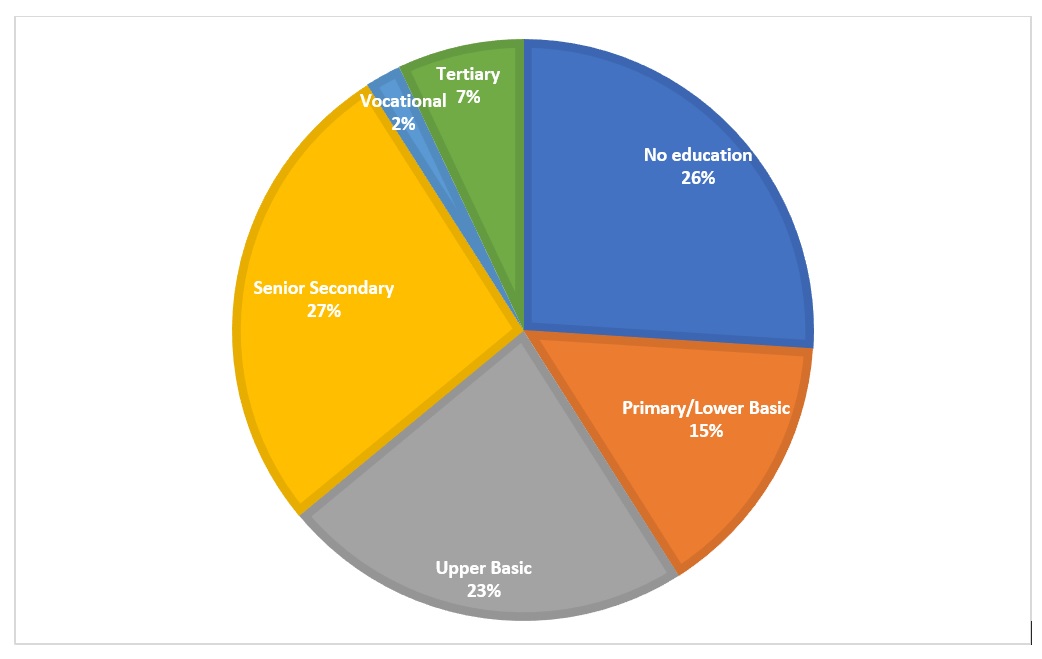
b. Poor educational opportunities: Youth, together with children, are the segments of the population most in need of education. Yet this group has been failed by the current administration. As the figure shows below, the majority of Gambian youth have not completed more than a high school level of education. Without quality educational training, our young people do not have the basic skills required for today's modern economy.

Figure 1: Educational profile of youths in The Gambia
c. Highly marginalized: Given the age range of youth (15-35), there is a range of educational and labor market activities in which they should be engaged. For the lower part of the age group, the primary preoccupation should be secondary education. At the lower-to-mid range, the main focus should be vocational training, tertiary education, and employment. At the upper end, the main focus should largely be the labor market and entrepreneurship. What is depressing in the Gambian context is that there is a high percentage of youth who are not in education, employment, or training. This percentage is 44% in The Gambia according to the Gambia Bureau of Statistics (GBOS). The prevalence of this category is higher in urban than in rural areas.

d. High percentage of informal employment: The small percentage of our youth with employment opportunities are in the informal sector. This usually entails low-quality employment with access to minimal benefits for individuals. This category includes carpenters, welders, masons, self-made artists, composers, emerging sports and many other endeavors. Over 75% of employed youth are in the informal sector. The prevalence of informal employment is higher in rural than in urban areas.

e. High teenage pregnancy: The Gambia continues to experience a high teenage pregnancy rate. About 40% of women of reproductive age had children before age 20. When individuals have children at such a young age, the opportunity to acquire education and other useful training becomes extremely limited. As a result, their ability to participate productively in the labor market becomes constrained throughout their lifetime, which has a knock-on effect on their families, particularly their children.

current state

3. The Government's Track Record

The current government does a particularly poor job of implementing results in areas that are cross-cutting in nature, such as youth issues. Specifically, the Ministry of Youth and Sports in The Gambia, as currently constituted, has no chance of advancing the interests of youth. Youth is not a sector but rather a cross-cutting theme that spans many sectors such as agriculture, education, health, industry, and others. The primary role of the Ministry of Youth should be quite different from other ministries by serving a coordinating function that cuts across all relevant sectors to ensure that the concerns of a major population group are being addressed.

An example is illustrative in this regard. The Ministry of Youth and Sports was given the responsibility of renovating the national stadium, which was disastrously handled. Millions of dalasi were lost in the debacle, with no consequences for the officials in charge. The renovation of the stadium should have been the responsibility of the Ministry of Infrastructure/Works, where the infrastructural capacity exists. The role of the Ministry of Youth and Sports should have been a supportive and coordinating function to ensure alignment with the country's youth policy and strategy.

In other words, given its cross-cutting nature, coordination within the government and across institutions is paramount to addressing youth issues. Without clearly defined mandates and proper coordination, there will be no delivery of results across the country. This is the main reason why the major problems facing youth - such as low educational outcomes, poor employment opportunities, poor sports infrastructure, and other social issues—continue.

intervention

4. Solutions

Following decades of repression and isolation under dictatorship (1994–2016), The Gambia has taken meaningful steps toward media freedom, transparency, and democratization. However, the work remains incomplete. Legal remnants of dictatorship—sedition laws, surveillance without oversight, and outdated press regulations—still exist. Therefore, reforms remain fragile and largely aspirational. The future of the IC sector lies at the intersection of governance, technology, and public empowerment.

a. Operationalize Access to Information (ATI): Despite the passage of the ATI Act, effective citizen access to vital information is still lacking in The Gambia. The PPA-led government will ensure all public bodies appoint ATI officers, publish information proactively online, and diligently honor information requests. Our government will build accessible government websites and online portals, and establish e-records systems across ministries to respond efficiently to ATI requests. We will conduct nationwide campaigns—including training for public officials and citizens—to promote use of ATI rights.

b. Enact Media Law Reform: Our government will fully repeal or significantly amend colonial-era laws (Information & Communications Act, Criminal Code clauses on sedition and false publication, Official Secrets Act, Telegraph Act, etc.) in line with the Media Law Review Committee's recommendations.

c. Independent Broadcasting Media Regulatory Authority: PURA, which regulates the utilities and mobile technology sectors, also regulates media. To ensure effective regulation of broadcasting media, content, and standards—requiring strong legal frameworks, independent oversight bodies, transparent processes, public accountability, and ongoing adaptation to technological changes—media regulation must be independent with credible experts leading the way.

d. Whistleblower Protection: The PPA leadership understands that it is the responsibility of every citizen to be vigilant about abuse, wrongdoing and other forms of misconduct in public offices. Therefore, citizens that reveal such misconduct deserve protection. The PPA-led government will advance legislation and regulations for whistleblower protection.

e. Legal Protections for Journalists: The harassment and intimidation of journalists and media personalities will end under our government. We will enact shield laws protecting journalists' sources and implement protections against Strategic Lawsuits Against Public Participation (SLAPP), such as defamation suits that have been used to target journalists under the Adama Barrow regime.

f. Media subventions: The PPA leadership recognizes the importance that media plays in a democratic society. And in order for the media to play it well, it needs some support. The PPA-led government will therefore institute a subvention system, which will have transparent criteria that will be developed through consultation and cooperation with the National Assembly, Gambia Press Union and civil society. To ensure integrity in the process and that resources are used for the intended purposes (e.g. capacity building and supporting reporters), strict and transparent processes will be put in place, as well as regular auditing.

solutions

Follow us on @ Electionify