Importance

1. Importance of Health

There can be no advancement without a healthy population. Health is important because it is both a fundamental right and necessary for development. A population that is not healthy cannot be productive in economic activities. An unhealthy population will also drain the limited resources of a poor country through the need for constant care. Indeed, the disease burden accounts for several percentage points of GDP in most developing countries.

Investments in health boost development in numerous ways. Healthier children have better attendance records in schools and are better able to reach their cognitive potential. Childhood, maternal, and adult mortality and morbidity are significantly reduced, thereby improving quality of life. Workers are more productive, leading to greater efficiency in the labor market.

2. Health in The Gambia

The current health situation in The Gambia is characterized by low access to quality health services, high diseases burden for both communicable and non-communicable diseases.

a. Low access to quality health care: Unfortunately, the quality and quantity of health services in The Gambia are far less than adequate. The health needs of the population are not being met with the current limited access and poor quality. Physical access to health services in The Gambia is not a major problem. This is not surprising. After all, The Gambia is a small, densely populated country. While individuals may not travel 100km in getting to a clinic, they frequently find health centers that are poorly staffed and devoid of essential pharmaceutical products. A daily occurrence in The Gambia is people visiting health centers with no drugs, poorly functioning equipment, and not enough trained health professionals.

b. High burden of infectious diseases: The Gambia still has high burden of infectious diseases, of which malaria is still among the major ones. These diseases are a major course of neonatal, maternal and adult mortalities. Malaria incidence is about 80 per 1000. Tuberculous cases are also on a rise in the country.


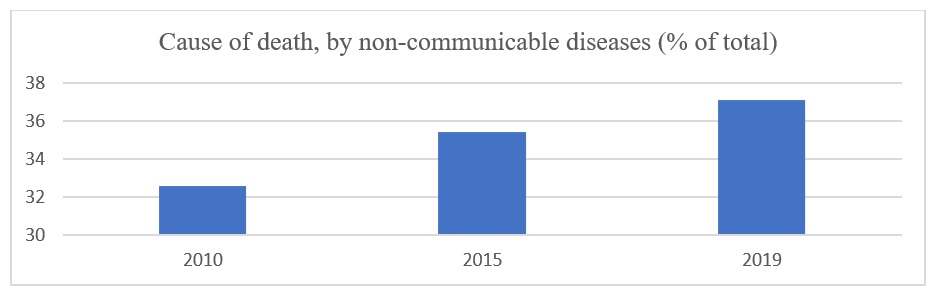
c. Increasing prevalence of non-communicable diseases: Non-communicable diseases, particularly cardiovascular diseases such as hypertension (high blood pressure) and diabetes, have on a rise in The Gambia. Hypertension prevalence in The Gambia is approximated at 29%—one of the highest in Africa. Other major non-communicable diseases in the country include liver cancer, coronary heart disease, and cirrhosis. Unfortunately, recognition of the fact that we have a major health crisis is non-existent with the current regime.

 Figure 4: Increasing rise of non-communicable diseases in The Gambia
d. Poor distribution of health facilities: Ensuring that people have adequate access to needed health services requires the distribution of health facilities within reasonable reach. The number and location of major hospitals in the country do not correspond well with the population distribution of the country nor reflect rising urbanization. The fastest growing urban areas of the country are still without major hospitals. The share of the population in urban areas is 62%, far above the African average of 40%. This increasing urbanization is not reflected in the health service delivery strategy of the country.

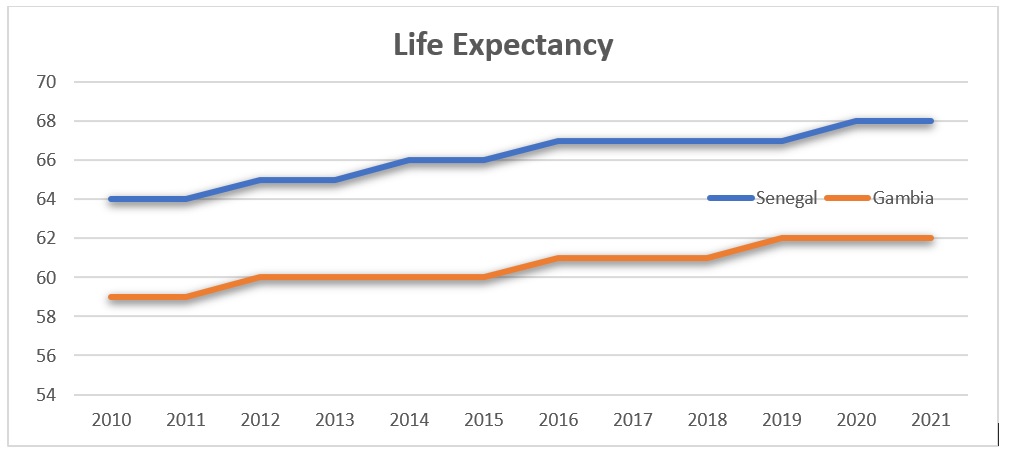
While the country has registered improvements in health outcomes, the rate is far lower than possible and well short of relevant SDG targets such as under-5 mortality rates. The slow rate of progress in health outcomes is the major reason why the life expectancy rate of The Gambia still trails that of Senegal.

 Figure 1: Gambian life expectancy, relative to Senegal
current state

Intervention

3. How well is the government performing?

The government of the day has a critical role to play in ensuring quality health access to the population.  As mentioned earlier, access to quality health services is quite limited in The Gambia, which underscores the failure of the current regime. This failure is manifested in poor planning, management and distribution logistics.

The low availability of essential medicines and their poor delivery system is one of the features of the Gambian health system. The problem starts with the fragmented system for medicine control in the country. Three main agencies are the National Pharmaceutical Services, Medicines Control Agency (MCA), and the Gambia Pharmacy Council. The roles and functions of these institutions frequently overlap. There is a significant lack of capacity, which is reflected in the absence of a comprehensive list of medicines in the country, lack of a modern computer-assisted drug registration system, a mismatch between the essential medicine list and actual drugs procured by the National Pharmaceutical Services, an inefficient drug procurement process that does not reduce costs, and limited storage capacity at the Central Medical Store, among others. The death of over 60 infants from contaminated cough syrup is one vivid manifestation of the fundamental problem the country has in its medicine control and regulation.

Health expenditures for Gambian households is quite high. This is reflection of the insufficient health sector investments by the central government. As in other sectors, the current government prefers to depend on foreign assistance. The Drug Revolving Fund, which should have received attention from the budget, is currently not functioning and is not providing the supplementary financing role that was envisioned.

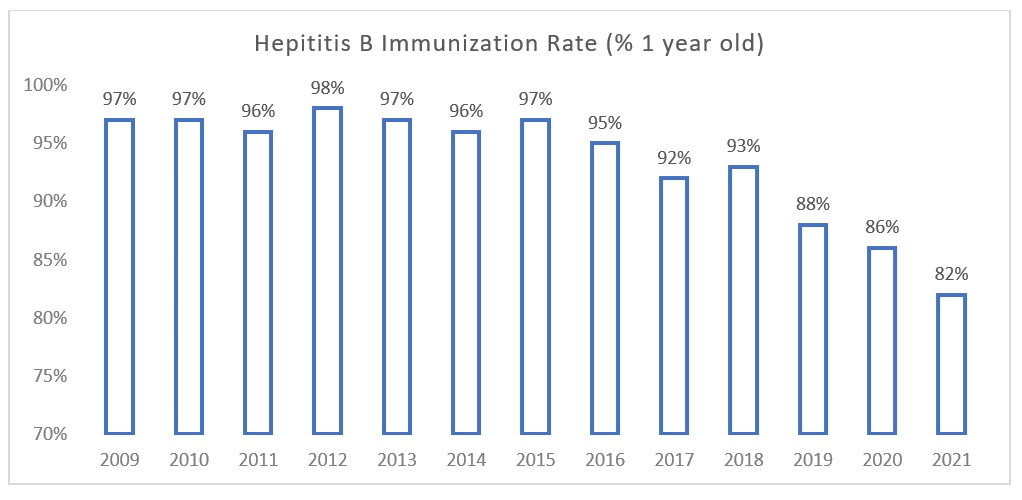
Another reason why household health expenditures are increasing is because there have been recent slippages in prevention, as demonstrated by a significant decrease in immunization rates since the arrival of the Barrow regime. This is not a trajectory for the country to adequately address its health needs.

Figure 2: Declining immunization rates of measles and DPT in The Gambia
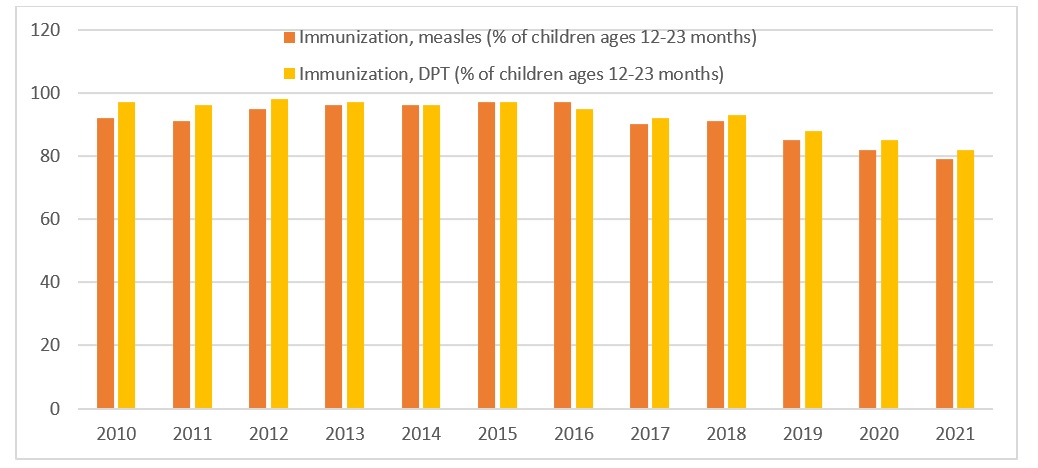
Figure 3: Declining immunization rates of hepatitis B in The Gambia

4. PPA's Solutions

Our health sector can be significantly improved when a government is in place that is led by competent officials who are driven by the goal to deliver quality and affordable health services to Gambians. Our government can be counted upon to achieve results in the health sector by addressing the following:

a. Emphasize preventative care: To ensure that the government adequately meets the expenditures from the health sector, the first important step is to control the demand for health services. If general health expenditures continue to rise uncontrollably, government support will never be sufficient no matter how big a share of the budget is allocated to it. This would require redoubling efforts on preventative care. Given the relative prevalence of communicable diseases in The Gambia, the PPA-led government would ensure that immunization planning and execution covers all relevant communicable diseases in The Gambia. These declining immunization rates will be reversed within the first year of this administration. Preventative healthcare will also include early screening for a range of diseases such as breast cancer.

Malaria is a one of the major non-communicable diseases whose burden can be significantly reduced through preventative actions. However, recent advances have resulted in promising vaccines. Our government will ensure that the Gambia would be one of the countries that is in front of the line when those vaccines are being distributed.

b. Tackle cardiovascular diseases: The Gambia is becoming highly urbanized and people are becoming sedentary. In addition, diets are rapidly changing and not for the better. This has resulted in an explosion of cardiovascular diseases such as hypertension and diabetes. The share of deaths caused by non-communicable diseases increased from 32% in 2010 to 37% in 2020. Fortunately, many of these non-communicable diseases are preventable with the right public health campaign. Our government will tackle this problem focusing on prevention and treatment.

c. Better control and management of medicine and medical products: Mismanagement and waste of medicine and medical products will be addressed by the PPA-led government. Effective delivery of quality health services requires the following:

  1. Efficient procurement processes of medicines and medical products in a cost-effective manner;
  2. Quality assurance process to ensure that contaminated products or those without active ingredients or expired or substandard products are not distributed in the country;
  3. Ensuring that the types of medicines and medical products procured match the disease burden of the country;
  4. Ensure that the storage system is of high quality to avoid degradation of medicines and medical products;
  5. Logistics system to ensure that medicines and medical products that are procured are delivered from Central Medical Store to regional medical stores, hospitals and health centers across the country without or theft.

For far too long, the health centers of the country are virtually empty of medicines and medical products. This is unacceptable and must change. Our government will ensure that each of the above key steps are implemented so that hospitals and health centers return to being well-equipped. As we witnessed in 2022 when over 60 Gambian children died from contaminated medicines, the price of a poor-quality system is too high.  The solution in designing any effective systems starts first with ensuring that the people in charge have integrity, are competent, have no conflict of interest and are provided the necessary resources. It also requires that the chain of responsibilities is clearly delineated so that individuals can be held accountable for meeting clearly defined targets. Our government can be counted upon to identify what the existing deficits are, and design a new and efficient system and execute it.

d. New and well-equipped hospitals: The PPA-led government will ensure that each administrative region would have at least one major hospital. Furthermore, the fastest growing urban regions in the country would also feature major hospitals. The provision of services should anticipate demand. With the high population growth rate of some areas of the country (e.g. Kombo North, Kombo South and Kombo Central), these are that require several major hospitals.


solutions

e. Improved Health Financial Management: Proper financing of health services, including essential medication, requires paying particular attention to revenue generation. An important source of revenue from the health sector are funds collected through user fees which are supposed to into the National Drug Revolving Fund (DRF). Unfortunately, DRF is not functioning as designed, with Ministry of Health officials having no information on revenue and expenses flows from it. A new generation of DRF is needed and would be established within the first year of our government. A new design with well-defined accountability structure would be put in place so that real-time financial data from the DRF can be monitored and assessed.


f. Major Administrative Reform: The current structure of the Gambia’s Ministry of Health needs a major reform. For one, there are far too many directorates – as of 2022, there are 10 directorates. This is far more than necessary in a single ministry. The fragmentary nature of the Ministry increases the difficulty of coordination and management in the sector.

g. Disaster Preparedness: The recent Covid-19 pandemic was a wake-up call to all countries in terms of preparedness for health emergencies such as disease outbreak. The current government has already shown how ill-prepared it is despite the presence of the Health Sector Emergency Preparedness and Response Plan 2017-2019. It is one thing to have a plan – it is another to properly execute it. With the world still battling Covid-19, and having witnessed the outbreak of other dangerous diseases such as Ebola in West Africa within the past decade, it is time we have a government in place that is capable of having a resilient disaster management plan in place.

h. Agriculture & Health Linkage: One of the strengths of the PPA leadership is the recognition of the inter-linkage between sectors. Two of the most rapidly increasing non-communicable diseases in the Gambia are cirrhosis and liver cancer. Indeed, these two diseases are major causes of deaths in the country. Aflatoxin, which is fungus found on groundnuts and prevalent in The Gambia, is one of the major causes of these two diseases. The presence of aflatoxin has reduced the value of Gambian groundnuts by excluding it from the lucrative European market. Through the control or eradication of aflatoxin in Gambian groundnut, improvements in health and agricultural productivity can be simultaneously tackled.

i. Health & Road Infrastructure Linkage: There are many communities in The Gambia where the physical distance between them and major health facilities seem small but the poor quality of the road effectively makes those facilities inaccessible. An example of where this is particularly true include villages in Upper Fulladou East. These communities may seem close to Bansang but the poor quality of the roads, especially during the reason, cuts them off. The PPA-led government would prioritize the construction of roads so that such situations no longer exist in our country.

Follow us on @ Electionify